Why Yoga Isn’t “Just Stretching”: Fascia, Bioelectricity, and the Real Power of Prana.

Picture this: you walk into a Yoga class, kick off your shoes, and tell a friend, “My hamstrings are screaming. I’m just here for a really good stretch.”
It’s the most natural thing in the world to say. On a purely mechanical level, tugging on tight muscle fibers can feel deeply satisfying. But if you’ve ever noticed that you can stretch the exact same tight spot every single day for a year and wake up just as stiff on Tuesday morning, you’ve brushed up against a fascinating truth:
Yoga was never designed to be an aggressive stretching routine.
When Sage Patanjali outlined classical yoga over two thousand years ago in the Yoga Sutras, he laid out a comprehensive map known as the eight limbs of yoga (Ashtanga). Physical Asana is just one of those eight limbs (we’ll save the other seven profound limbs for future posts!). But out of nearly two hundred aphorisms dedicated to human consciousness, do you know how many verses Patanjali actually devoted to physical movement?
Barely three.
Here is why: in Sanskrit, the word Asana doesn't mean an acrobatic "posture" or an aesthetic "pose." It literally translates to “seat”—a place of resting, abiding, and dwelling.
Patanjali defined it as Sthira Sukham Asanam—a seat that is simultaneously steady, stable, and filled with ease. The objective was never to force your body into a picture-perfect shape, but to use movement to inhabit your inner “seat”—the quiet home where Prana (your vital life force) naturally resides.
This brings extraordinary clarity to what we are actually doing on the mat: Asana is a method of nervous system regulation. By moving, hydrating, and gliding the living web of your fascia, you send a direct sensory message back to your brain: “We are safe right now.” Only when the nervous system registers safety can the tight, clenched, defensive holding patterns we carry finally drop their armor and release.
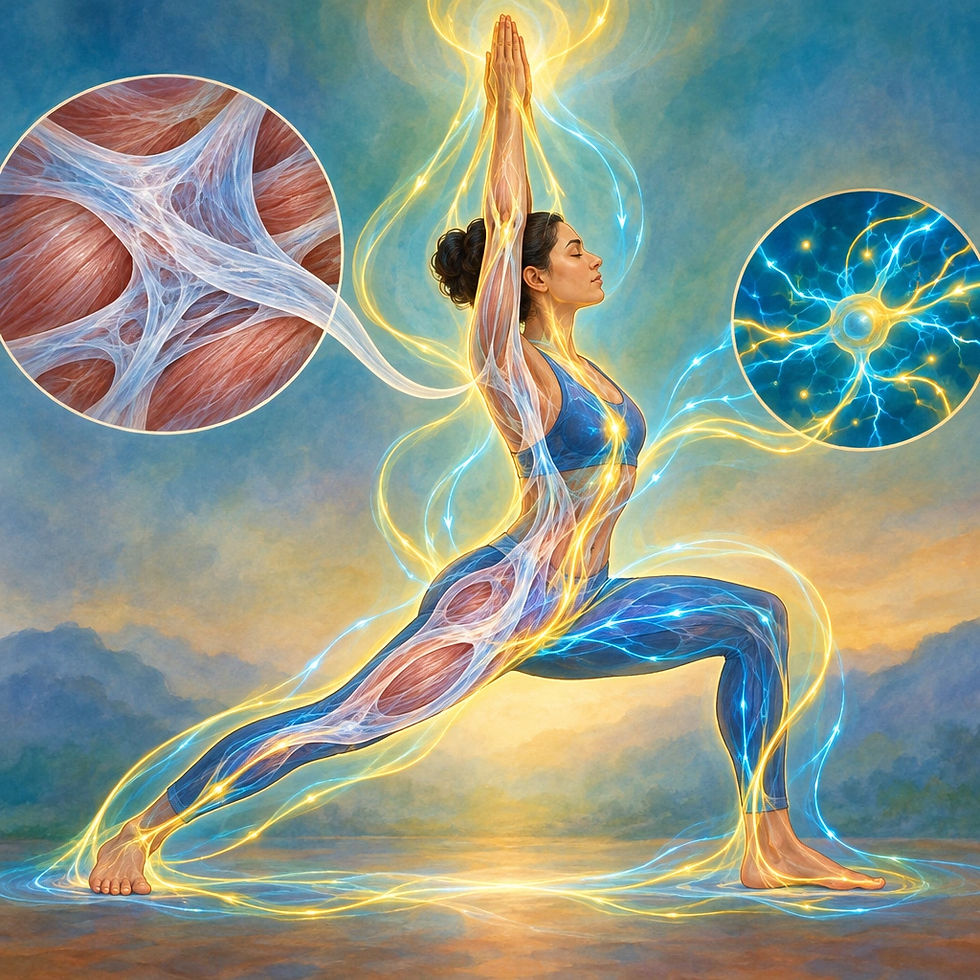
Muscle Is Just one of the Layers (Meet the Fascia)
When we think of physical movement, our minds usually jump to muscles: biceps contracting, quads firing, hamstrings lengthening. But muscle is only the superficial actor on the stage. Wrapping around every individual muscle fiber, nerve, bone, and internal organ is a continuous, three-dimensional web called fascia.
For decades, traditional dissection treated fascia like biological packing peanuts—disposable cling wrap that surgeons tossed aside to get to the "important" anatomy.
Today, researchers know that fascia is our richest sensory organ. It is an unbroken, fluid-filled, crystalline matrix. When it is healthy and hydrated, its microscopic layers glide like silk and conduct bioelectric impulses throughout your entire body at speeds far faster than nerve transmission. But when it becomes dehydrated, chronically stressed, or emotionally braced, that fluid dries out. The tissue glues together like industrial Velcro, the electrical signals sputter, and physical movement stalls.
Where Bioelectricity Meets Prana (Plugging In Your Battery)
What contemporary cellular biophysicists call semiconductive bioelectricity, ancient wisdom identified thousands of years ago: Prana; the intelligent, animating life force that forms the cornerstone of Ayurveda and Yoga. Flowing alongside this living tissue network are the Nadis; the 72,000 subtle energy channels mapped by yogic anatomy.
Even if you step onto your mat with the modest intention to simply "stretch out your hips," something infinitely more profound is taking place.
As you gently load, twist, and unwind your tissues, your fascia acts like a compressed sponge releasing under water: it draws in fresh lubricating fluid. And depending on what has been held and for how long—in tight hips, restricted shoulders, locked ankles, braced back or a guarded chest—old cellular memories, buried emotions, and unresolved stress finally get the green light to surface.
The asana creates the safe container that allows that trapped stagnation to come to the surface, and your pranayama (conscious breath pattern) is what actually metabolizes, digests, and releases it.
The moment movement returns to areas that were previously locked and stagnant, the bioelectric circuit switches back on. More hydraulic glide means more electrical conductivity—which means more flowing Prana.
You aren't just limber; you are literally recharged.
When your internal battery feels drained down to 1% after a chaotic week, this is why stepping onto your mat or sitting in quiet meditation revives you from the inside out. You aren't just working out—you are plugging your living system back into its power source. Bam! Charging!
From "Bhogi" to "Yogi": Tuning the Temple
Classical yogic philosophy contains a playful distinction between a Bhogi and a Yogi.
A bhogi is an enjoyer or consumer of sensory stimulation. In modern fitness culture, it’s effortless to practice as a bhogi: treating the mat like an all-you-can-eat buffet of intense sensations, chasing an endorphin rush, or treating the body like an unruly machine that needs forceful discipline.
A yogi sees the vessel with reverent eyes. The body is not an obstacle to conquer; it is Deha Devalaya—a living temple.
If your body is a temple, then asana (movement towards stillness), pranayama (breath), and mantra (sacred vibration) are not competitive sports. They are tuning tools.
Think of a sitar or violin: pull the string too loose, and it will not play a note; wrench it too tight, and it snaps. When you align your posture on the mat, you aren't trying to force yourself into an arbitrary magazine-cover shape. You are adjusting the tension of your inner strings so that your cellular vibration can resonate cleanly and clearly.
Inhabiting Who You Already Are
The true heart of yoga is never about running after something outside yourself that looks like more flexibility, a tighter waistline, or a dramatic pose.
It is about finding that steady, easeful seat within your living, breathing, bioelectric vessel—dissolving old shock, reminding your nervous system that it is safe to let go, and remembering the quiet wholeness that was always there.
The next time you step onto your mat, let go of the urge to pull your edges apart. Don’t ask, “How deep can I stretch today?”
Soften your eyes, unclench your teeth, take an expansive breath into your back body, and ask: “How freely can my energy settle into its seat today?”
Exhale of the Month:
Wherever you are reading this, soften the soles of your feet, unlock your knees, and let your lower belly be completely soft.
Inhale deeply through your nose, imagining breath hydrating the dry spaces between your tissues. As you exhale, let out a soft, open sigh or a gentle hum.
Notice that subtle buzzing sensation settling in your chest and throat. Your body doesn't always need force to release—it just needs to know it is safe.
📚 Science & Somatic Research (References)
Oschman, J. L. (2015). Energy Medicine: The Scientific Basis (2nd ed.). Elsevier Health Sciences. (Details the "living matrix" of the body—how connective tissue and the extracellular fascial matrix function as a continuous, semiconductive, piezoelectric network capable of transmitting bioelectrical signals and cellular information).
Langevin, H. M., et al. (2001). Mechanical signaling through connective tissue: A mechanism for the therapeutic effect of acupuncture. The FASEB Journal, 15(12), 2275–2282. (Demonstrates that sustained, gentle mechanical stretch of connective tissue stimulates cellular mechanotransduction, dynamic shape change in fibroblasts, and widespread tissue relaxation beyond simple muscle stretching).
van der Kolk, B. A., et al. (2014). Yoga as an alternative and complementary treatment for posttraumatic stress disorder. The Journal of Clinical Psychiatry, 75(6), e559–e565. (A landmark clinical trial showing that trauma-informed yoga significantly reduces PTSD symptoms and emotional numbing by improving interoceptive awareness, physical tolerance of inner sensations, and heart-rate variability/autonomic balance).
Schleip, R., & Jäger, H. (2012). Fascia as a sensory organ: A modern update on fascial innervation. In Fascia: The Tensional Network of the Human Body (pp. 77–84). Churchill Livingstone. (Highlights that fascia is richly innervated with mechanoreceptors and interoceptors, explaining how mindful movement alters global muscle tone, down-regulates sympathetic nervous system overdrive, and aids in shock/trauma release).


Comments